
Licensing
Licensing and policies
The license, the training behind it, and the house rules that come with it, taken from the policies every family signs.
California facility number 376628606
- License
- Large family child care home, licensed for 14 children
- Provider
- Leticia C. Rojas
- Background
- Placed on the California TrustLine Registry in April 2017
Check us before you call
Every licensed facility in California is listed in a public database, with its inspection history. Look this number up. Look up the other homes you are considering too.
California Care Facility Search
Or call Community Care Licensing and ask for this home's license history:
In her own words
Four passages from the policies the provider wrote herself, exactly as she wrote them, in English and in Spanish.
Philosophy
My philosophy is that all children should be treated with respect. All children have the right to safe, healthy, nurturing care and opportunities for developmental activities appropriate to their ages, special needs, talents, and interests.
Mission
My goal is to provide your child with a clean, safe, comfortable environment in which to play and learn with the proper counseling and special care while you are at work or attending school.
Behavior and guidance
Your child’s personal rights will be respected by using behavior guidance that is fair, reasonable, and suited to the age of the child. This includes natural and logical consequences and redirection to guide their behavior. Corporal (spanking) or verbal punishment will not be allowed or tolerated.
If a child keeps hitting, biting or breaking toys, you will be asked to meet and agree a plan together, which may bring in extra support for your child's social and emotional well-being.
Hygiene, health and safety
Our home emphasizes strict cleanliness and hygiene standards. Children’s hands are washed before and after meals, coming in from outside and after toileting.
The house is smoke-free, as state law requires during care hours. There is no swimming pool; a wading pool comes out in the warm months. There is a small dog in the home.
House policies
The short version. The full text is in the parent handbook, which you read together and sign at enrollment.
- Sick children stay home
- Children who may be contagious stay home: fever, vomiting, diarrhea, a severe cough, flu, a swollen neck, an unexplained rash, pink eye, chickenpox, head lice, scabies or hand-foot-and-mouth disease. After a fever, a child comes back only after 24 hours without fever and without fever medicine. After vomiting twice or more in a day, 24 hours after it stops.
- If your child gets sick or hurt here
- You will be called to come and collect them. For a serious injury, 911 is called first, and then you.
- Medication
- Prescription and over-the-counter medicines, ointments and creams can be given when needed, once you have filled in the form, in the original container labeled with your child's name.
- Immunizations
- State law requires an immunization record for every child in licensed care. Keep your child's shots up to date and give us a current copy.
- Who may collect your child
- Only you and the people named on your emergency card. Anyone else needs your written permission in advance. If a court order keeps a parent away, a written note saying so from the custodial parent must be on file here; without it, that parent cannot be stopped at the door.
- Car seats
- Children come and go in a proper car seat. If an adult arrives without one, or under the influence of alcohol or drugs, someone on the emergency card is called to collect the child, or a taxi is called for the adult and child at the adult’s cost, or the adult goes home and comes back with a car seat. If none of these is accepted, the police are called.
- Emergencies and disasters
- There are written plans for fire, flood, earthquake and other emergencies, and the children practice drills.
- Photos
- Your child is photographed only with your written permission. Photos are shared only with enrolled families, in the parent portal, and you can ask Lety for a copy of any photo of your child.
- Privacy
- Records and information about your child and family stay private and confidential unless you give written permission to share them.
- Mandated reporting
- The provider is required by law to report any suspected physical, emotional or sexual abuse or neglect. If you suspect a child here is being mistreated, tell her immediately; you may also report it to Community Care Licensing or child welfare services.
- Everyone is welcome
- No family is refused care because of race, color, sex, creed, religion, age, disability, national or ethnic origin, sexual orientation, public assistance status or medical condition, as long as the program can meet the child’s needs with reasonable accommodations.
- Concerns and complaints
- Bring any concern to the provider as soon as possible. If a serious complaint is not being addressed, you may contact the home's licensing analyst at Community Care Licensing.
On file
Training since 2017
Leticia Rojas has kept up her training since 2017: child development, safety, nutrition and the law. Here are six of the certificates on file. The full list is below them.
-
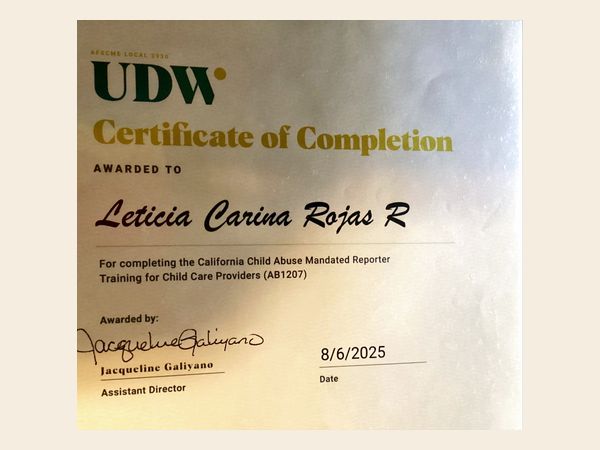
Mandated reporter of child abuse (AB1207) -
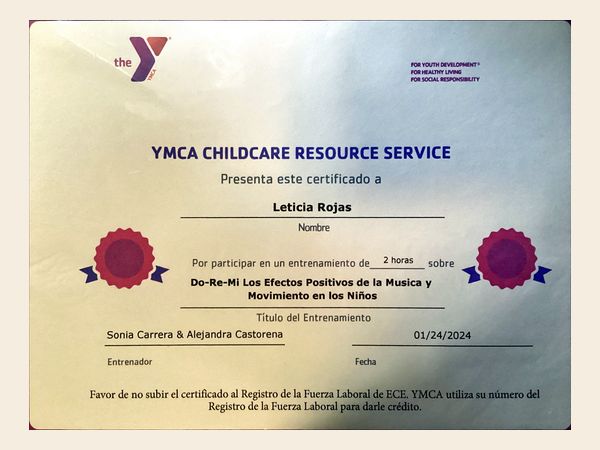
Music and movement for young children -
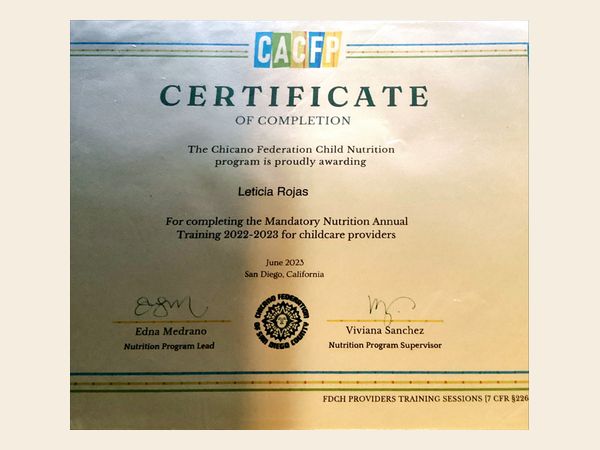
Child nutrition, CACFP annual training -
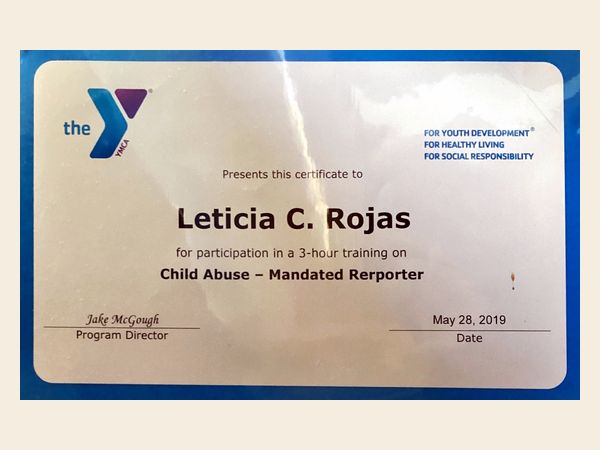
Child abuse: the mandated reporter -
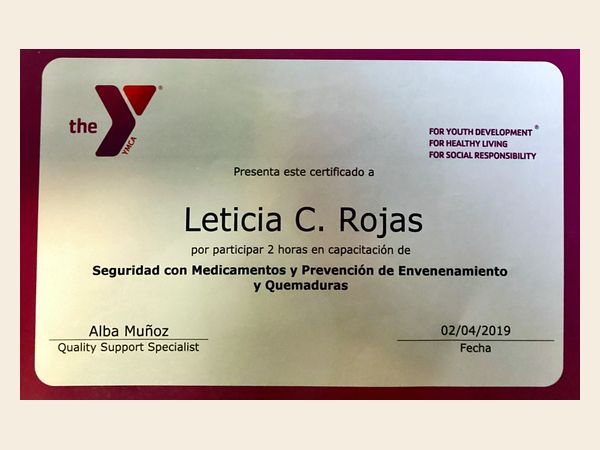
Medication safety, poisoning and burns -
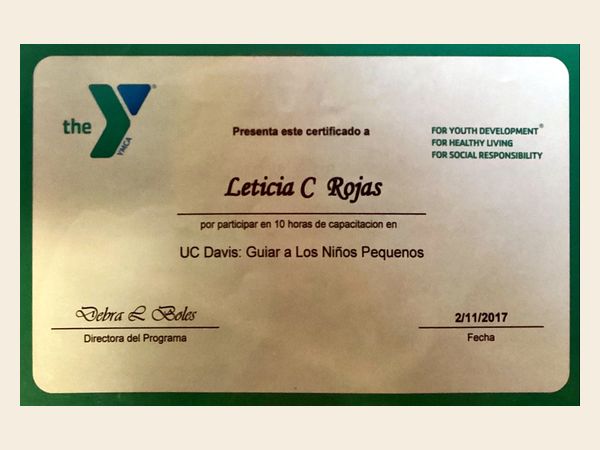
Guiding young children (UC Davis)
Every training on file, 2017 to 2025
| Date | Training | Hours | Given by |
|---|---|---|---|
| Aug 2025 | California child abuse mandated reporter training for child care providers (AB1207) | Not stated | UDW |
| May 2025 | Child abuse and neglect mandated reporter training, with exam | 4 | California Department of Social Services |
| Jul 2024 | CACFP mandatory nutrition annual training, 2023–2024 | Not stated | Chicano Federation |
| Jan 2024 | Do-Re-Mi: the positive effects of music and movement on children | 2 | YMCA Childcare Resource Service |
| Jun 2023 | CACFP mandatory nutrition annual training, 2022–2023 | Not stated | Chicano Federation |
| Mar 2023 | Staying organized | 1.5 | YMCA Childcare Resource Service |
| Jul 2022 | Creating loving routines for learning | 1.5 | YMCA Childcare Resource Service |
| May 2019 | Child abuse: the mandated reporter | 3 | YMCA |
| Feb 2019 | CACFP annual training, 2018–2019 | Not stated | Chicano Federation |
| Feb 2019 | Medication safety, and preventing poisoning and burns | 2 | YMCA |
| Jan 2019 | Injury prevention in child care, and transportation risks | 2 | YMCA |
| Oct 2018 | The family child care business: taxes and record keeping | 3 | YMCA |
| May 2018 | Developing your contract and policies | 3 | YMCA |
| Aug 2017 | Immunizations | 2 | YMCA |
| May 2017 | UC Davis: serving children with special needs and their families | 5 | YMCA |
| May 2017 | Discovery baskets (CCIP support group, module 3) | 2 | YMCA |
| Apr 2017 | CD 81 Children in Family Childcare: Crisis, Challenges & Changes | Not stated | Southwestern College |
| Apr 2017 | Introduction to environment rating scales | 3 | YMCA |
| Apr 2017 | Art and children | 3 | YMCA |
| Mar 2017 | Ask the experts: protecting a home daycare business | 2 | YMCA |
| Mar 2017 | Managing time and stress | 3 | YMCA |
| Feb 2017 | The family child care business: managing income and expenses | 3 | YMCA |
| Feb 2017 | UC Davis: guiding young children | 10 | YMCA |
| Feb 2017 | CCIP support group, module 4 | 2 | YMCA |
| Jan 2017 | Understanding the home child care business | 3 | YMCA |